Late last year, I wrote about why we began digiDirect’s digital transformation with humans, not hype.
We set out to create an elegant, clearer and more intuitive digital experience one that felt less like navigating a complex ecommerce system and more like being assisted by a knowledgeable in-store concierge.
Our principle was simple:
Retail technology should adapt to people not force people to adapt to technology.
At the time, the Digital Concierge was partly a vision of what could come next. Today, following the successful launch of our new digiDirect experience, that vision is becoming real.
We have created an agentic conversational commerce experience that brings search, conversation, product discovery and customer assistance together around one thing: customer intent.

Customers Should Not Have to Choose a System
On most ecommerce websites, search and chat remain separate.
The Search Bar sits at the top of the page. A Chatbot waits in the bottom-right corner. Product recommendations, comparisons and customer support operate through still more disconnected experiences.
This places an unnecessary burden on the customer.
- Should they search, browse or chat?
- Is their question about a product or customer service?
- If they move between these systems, will they need to explain everything again?
We wanted to remove that Cognitive Load.
For a customer, searching and asking are not fundamentally different activities. Both begin with a person trying to find something, understand something, decide something or resolve something.
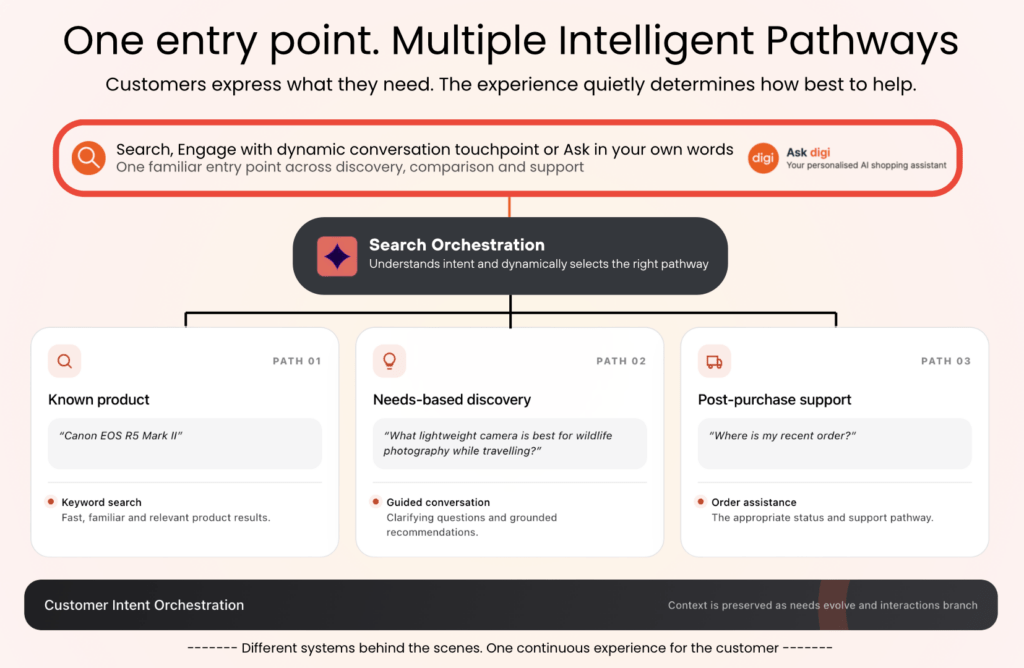
On digiDirect, a customer can enter a product name and conduct a familiar keyword search:
- “Canon EOS R5 Mark II”
They can type a long-tail question based on a specific need:
- “What is the best lightweight camera and lens combination for wildlife photography while travelling?”
In the same experience, they can ask a post-purchase question:
- “Where is my recent order?”
These requests may all begin in the same place, but they represent very different intentions. Each needs to be understood and directed towards the right capability.
Search Orchestration: One Entry Point, Multiple Pathways
This is where Search Orchestration becomes important.
Instead of forcing every query through the same mechanism, the experience interprets the request and dynamically selects the most appropriate pathway.
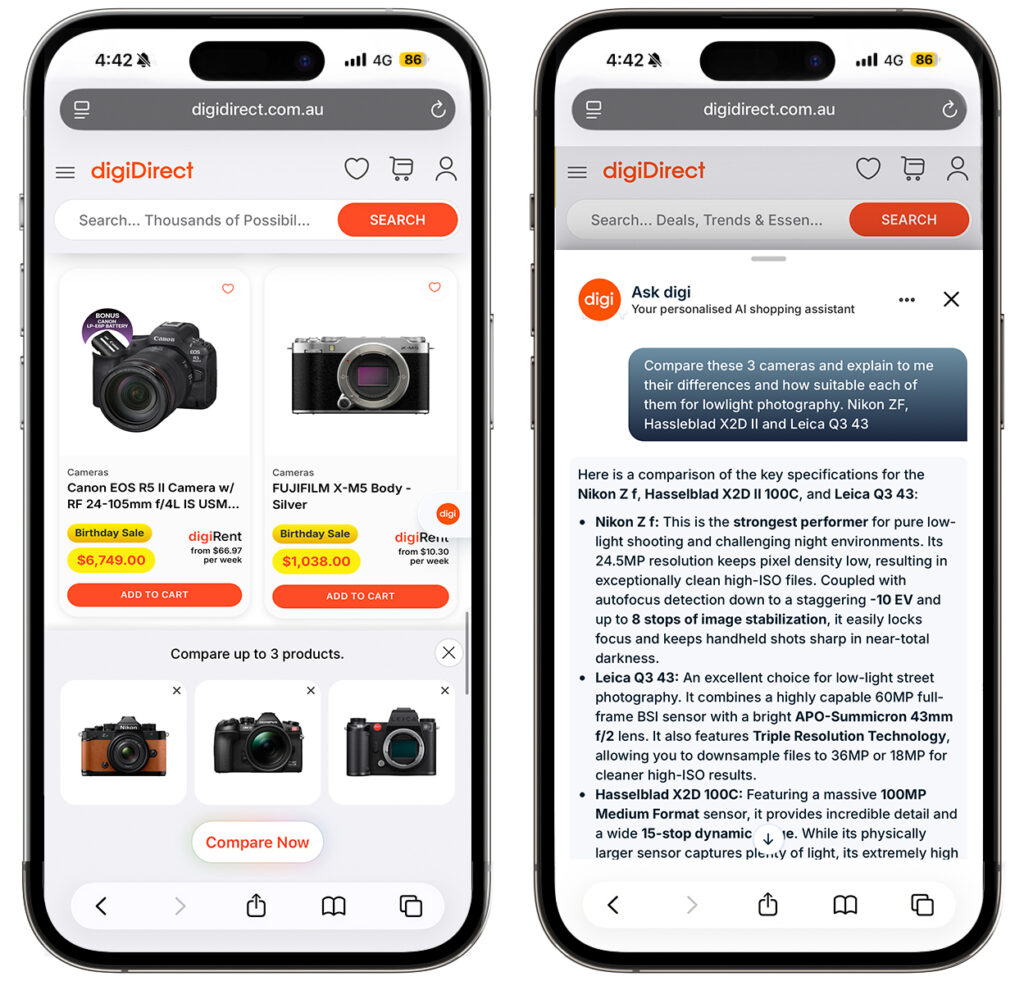
A direct product query can produce a fast, conventional keyword-search experience. A long-tail or needs-based question can become a guided product-discovery conversation. The agent can clarify the customer’s requirements, compare suitable options and explain why particular products may be relevant.
A question about an existing order can branch into the appropriate post-purchase pathway.
The customer does not need to decide which system to use, locate a separate chatbot or understand how our technology is organised.
They simply express what they want to achieve.
The orchestration happens quietly underneath.
Customer Intent Orchestration: Maintaining Context as Needs Evolve
Search Orchestration determines how an individual request should be handled. Customer Intent Orchestration goes further.
It maintains an understanding of what the customer is trying to accomplish as the interaction develops.
A customer might begin with a broad question, refine their requirements, compare products, ask about compatibility and then move to a question about delivery. The nature of the journey may change, but the experience should not feel as though the customer is being repeatedly transferred between disconnected systems.
Our Intelligent Orchestration Layer dynamically branches these interactions while maintaining contextual awareness throughout.
Behind the scenes, the experience may move between traditional search, conversational discovery, product recommendations and post-purchase assistance. To the customer, it remains one continuous journey.
This is the difference between adding another chatbot and creating an intent-driven commerce experience.
Intelligence That Feels Almost Invisible
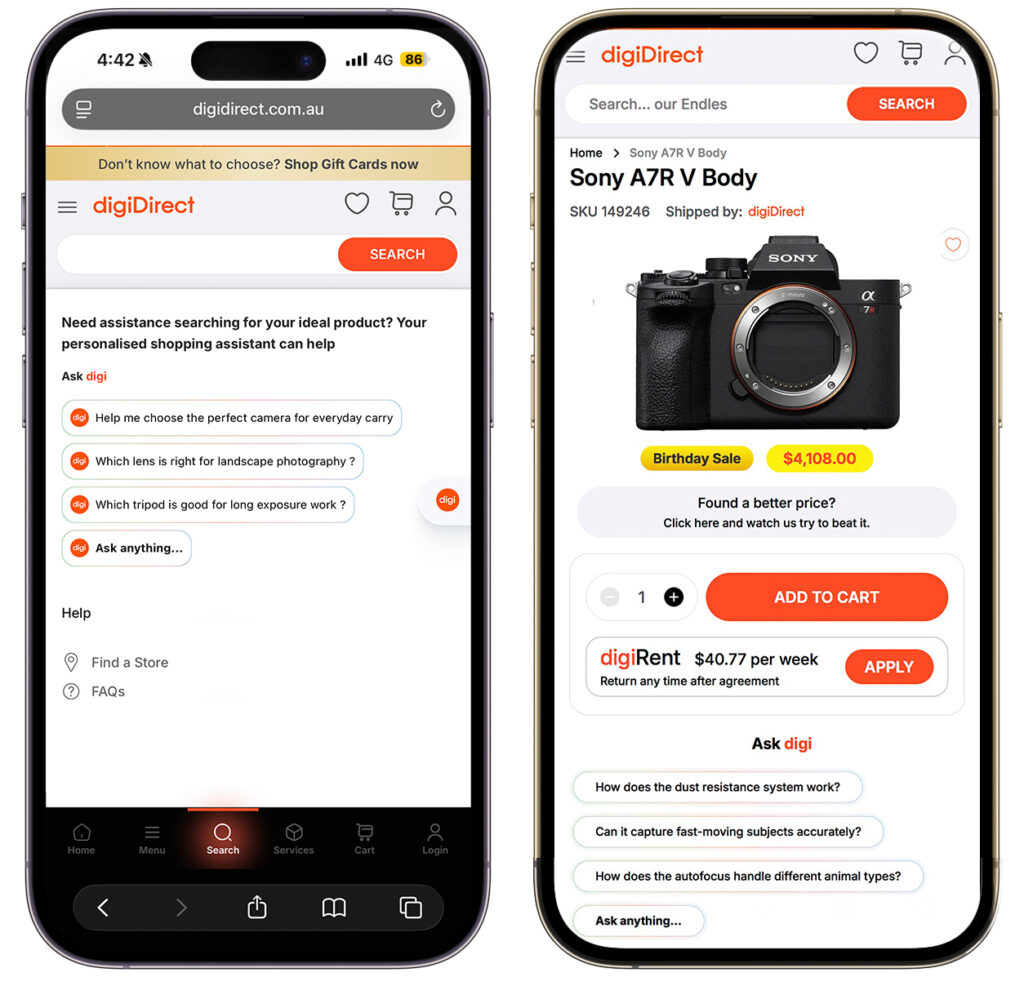
Our implementation was driven as much by usability as it was by AI capability.
We did not want to cover the website in AI labels, animated prompts or messages announcing how intelligent the technology was. Customers visit digiDirect because they care about photography, content creation and technology not because they want a demonstration of our technology stack.
The best technology often feels almost invisible.
A customer should simply feel that the website understands their request, chooses the right pathway, provides useful information and makes the next step easier.
Every part of the experience was considered through that lens: where assistance appears, when it becomes visible, how much information it presents and how naturally the customer can move between search, conversation and product exploration.
A prompt appearing too early can feel intrusive. Too many recommendations can increase rather than reduce cognitive load. An overly confident answer can weaken trust.
The experience therefore had to be engineered with both precision and empathy.
The agent remains quietly accessible. It assists without demanding attention, makes recommendations without creating pressure, and knows when to help and when to let the customer browse.
When it works well, customers do not think, “I am using an AI agent.”
They think, “This is making it easier to find what I need.”
Broad Understanding, Grounded Recommendations
Large language models give conversational agents the ability to understand natural language and draw upon broad contextual knowledge.
That matters in complex retail categories.
Helping someone choose equipment for wildlife photography involves more than matching keywords. It requires an understanding of distance, movement, autofocus, focal length, portability and budget. Supporting someone building a podcast studio may require knowledge spanning microphones, interfaces, headphones, acoustics and connectivity.
But broad knowledge alone is not enough.
AI commerce agent must remain accountable to the retailer’s product catalogue, availability and trusted product information.
Our approach combines both forms of intelligence.
The broader contextual knowledge helps the agent understand what the customer is trying to achieve. Product recommendations are then grounded in the catalogue available through digiDirect.
This creates essential guardrails. The agent can interpret a need intelligently, but it does not simply improvise product recommendations. Trusted catalogue information anchors the response, while conversational context helps explain why particular options may be suitable.
Agentic commerce should not mean surrendering control to an opaque algorithm. It should mean allowing technology to assist more actively within carefully designed boundaries, supported by reliable information and ongoing human oversight.
From Digital Assistant to Trusted Concierge
In my previous article, I described our personalisation philosophy as a “VIP concierge, not a pushy salesperson.”
Agentic conversational commerce takes that idea further.
A good concierge listens before recommending. They recognise uncertainty, ask relevant questions and reduce complexity into a manageable set of choices. They know when to step forward and when to step back.
That is the standard we brought to this experience.
The agent is not designed to chase customers around the website or force every visit into a conversation. It is intended to feel more like an empathetic and dependable friend available when useful, but comfortable allowing customers to explore independently.
Within just weeks of launch, we began to see significant customer interest and stronger engagement across AI-assisted discovery journeys.
Customers appeared increasingly comfortable expressing their needs in their own words, exploring recommendations conversationally and depending on the experience as part of their decision-making process. This comfort led to deeper product engagement and stronger progression towards conversion.
Trust was not created by making the AI louder. It developed because the experience repeatedly demonstrated that it was useful, reliable, considerate and worthy of the customer’s confidence.
A Foundation for The digiDirect Group
Making this experience possible required more than modernising the technology beneath digiDirect.
Selecting a core technology stack is a consequential strategic decision. It demands rigorous research, a clear understanding of the experience you want to create and close alignment with your long-term technology vision. The right foundation can accelerate that vision; the wrong one can constrain it before it has the opportunity to become real.
But selecting the technology stack alone will never take you the full distance.
No platform arrives perfectly aligned with an organisation’s ambition, operating model or customer-experience roadmap. Realising the vision requires carefully shaping those capabilities around the outcomes you want to deliver, not simply adapting your vision to what the technology provides out of the box.
That means collaborating closely, challenging assumptions and co-creating solutions where necessary. It also means contributing practical retail insight that can help refine and influence the broader product roadmap creating stronger alignment with our vision while generating value that can extend beyond our own implementation.
Technology selection establishes what may be possible. Thoughtful implementation, deep collaboration and purposeful co-creation determine what ultimately becomes real.
Choosing the right technology stack is pivotal, but that is not the story we want customers to notice.
The story is the Experience they make possible.
Our new technology architecture now provides a unified technology foundation for the broader digiDirect Group including digiDirect, Mwave, Booktopia, Angus & Robertson and James Bennett.
Each brand has a distinct audience and purpose. A photographer selecting a lens has different needs from a reader discovering their next book or a technology enthusiast building a high-performance computer.
A unified technology foundation does not mean making every brand feel the same. It means giving each brand access to a shared intelligence layer that can be shaped around its customers, catalogue, expertise and identity.
The foundation can be common while the concierge remains unmistakably connected to the brand it represents.
Behind this transformation is our Visionary Founder & CEO Shant Kradjian and our Fearless Group Director Haig Kayserian , who genuinely believes in what we are building, inspires us to think boldly and guides us as we turn an ambitious human-centred technology vision into reality.
Making the Vision Real
We began this transformation by asking how the experience should feel: calmer, clearer, more intuitive and more supportive.
Only then did we introduce the deeper intelligence beneath it.
That sequence matters. Agentic AI is most valuable when it amplifies a strong customer experience. It cannot compensate for confusing journeys or technology that constantly demands attention.
The concierge I imagined in the previous chapter is no longer simply a metaphor.
It is becoming part of the experience itself.
Through Search Orchestration, it can select the right pathway for each request. Through Customer Intent Orchestration, it can preserve context as the customer’s needs evolve. Through carefully designed guardrails, it can combine broad understanding with dependable product recommendations.
Yet it does so quietly, always available, consciously engineered and designed to assist rather than interrupt.
This is the kind of AI experience we believe customers deserve: intelligent without being intimidating, proactive without being intrusive, and commercially effective because it is genuinely helpful.
Our original principle remains unchanged:
Keep the customer at the centre, not the algorithm.
What has changed is our ability to make that principle real at scale.
And for The digiDirect Group, this is only the beginning.
Article written by:
Sachi Wickramage
Head of Technology & Experience
The digiDirect Group